









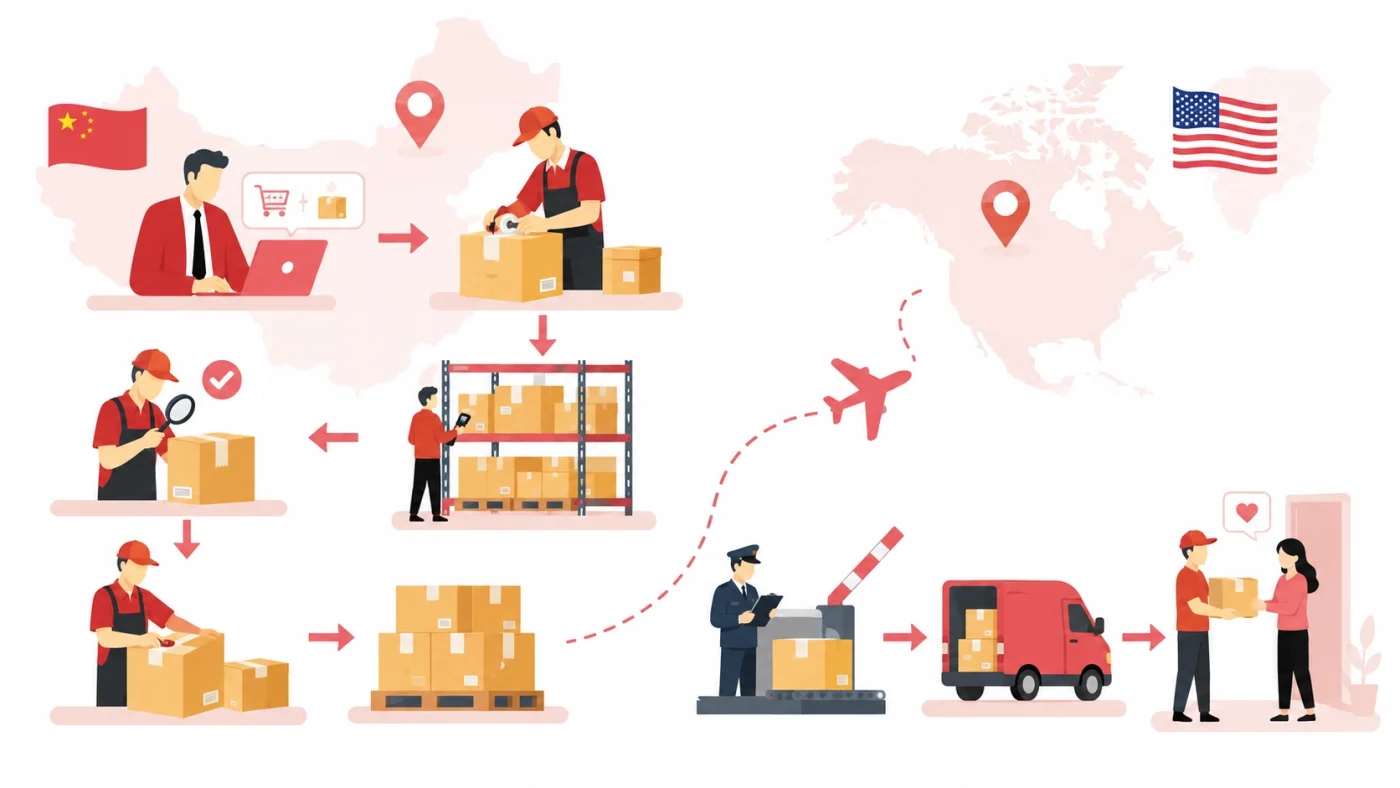
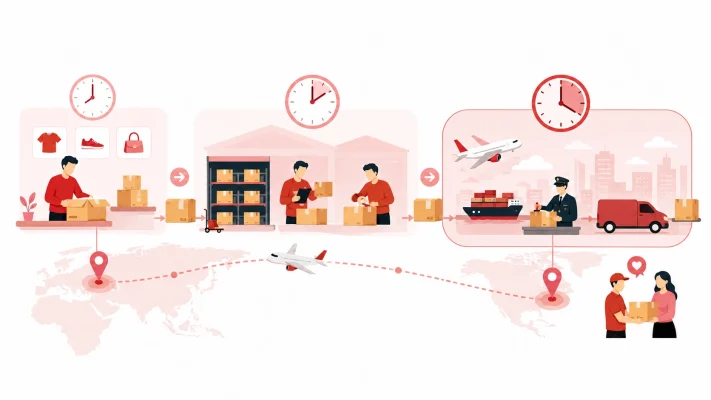
Dropshipping shipping time from China to the USA is not determined by the flight alone. Before a parcel reaches an international carrier, the product may still need to be sourced, transferred to a warehouse, inspected, packed, labeled, and handed over for shipment.
That is why two stores using similar shipping routes can have very different delivery results.
If you want faster delivery, the first question should not be “Which carrier is fastest?” It should be “Where is the order actually spending its time?”
This guide breaks the delivery journey into the stages that matter most, explains how to identify the source of a delay, and shows what Shopify sellers can improve without automatically paying for expensive express shipping.
How Long Does Dropshipping Take From China to the USA?
There is no single number that applies to every dropshipping order.
The important distinction is between transit time and total delivery time.
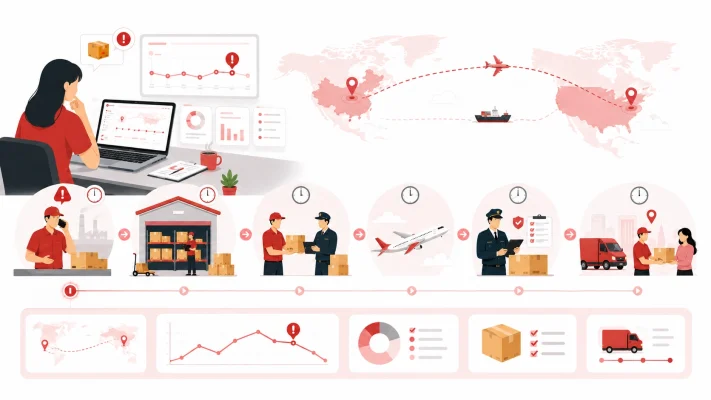
For a dropshipping store, the real timeline looks more like this:
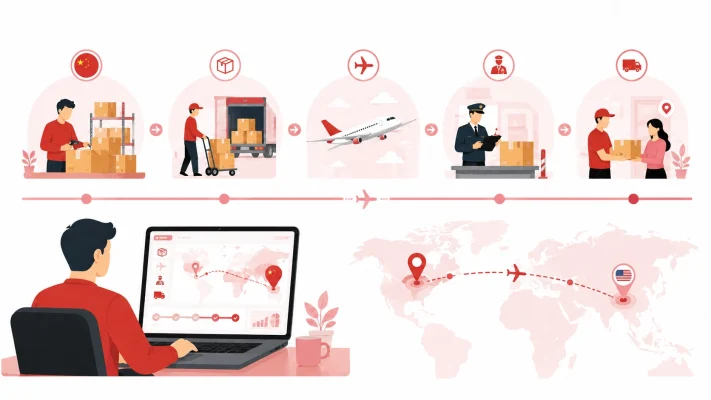
Customer order → sourcing or stock allocation → warehouse arrival → inspection → packing → carrier handoff → international transit → US delivery
If one of those stages adds three extra days, your customer experiences those three days even if the shipping line itself performs perfectly.
1. Product Availability Can Delay an Order Before Shipping Begins
The first question is simple:
Where is the product when the customer places the order?
“Available” does not always mean physically sitting in the fulfillment warehouse.
The item may be:
- Ready in warehouse inventory
- Available from a nearby supplier
- Purchased only after a customer orders
- Waiting for production
- Available in one variant but not another
- Waiting for custom packaging
This difference has a major effect on China to USA dropshipping shipping time.
Imagine two orders using exactly the same shipping line.
Order A is already stocked and can move directly to inspection and packing.
Order B first needs to be purchased from a supplier, transported domestically, received by the warehouse, and checked.
The international transit may be identical, but Order B starts that journey several days later.
For products with stable sales, better inventory planning can therefore save more time than switching carriers.
2. Supplier Processing Is Often Hidden Inside “Shipping Time”
Supplier lead time is another stage customers never see.
After an order arrives, a supplier may need to confirm the variant, prepare the product, receive payment, package it for domestic transport, and send it to the fulfillment warehouse.
If you are trying to understand delivery time from China, separate this supplier stage from international shipping.
Instead of asking:
“How many days is shipping?”
Ask:
“How long until the product reaches the fulfillment warehouse?”
and:
“How long from carrier collection to customer delivery?”
That immediately gives you a more useful picture.
A sourcing agent can help coordinate supplier availability, purchasing, and product movement, but sellers should still know whether a delayed order is waiting for the supplier or already inside the fulfillment process.
Without clear statuses, everything becomes “processing,” and that makes delays almost impossible to diagnose.
3. Warehouse Processing Can Add—or Remove—Days
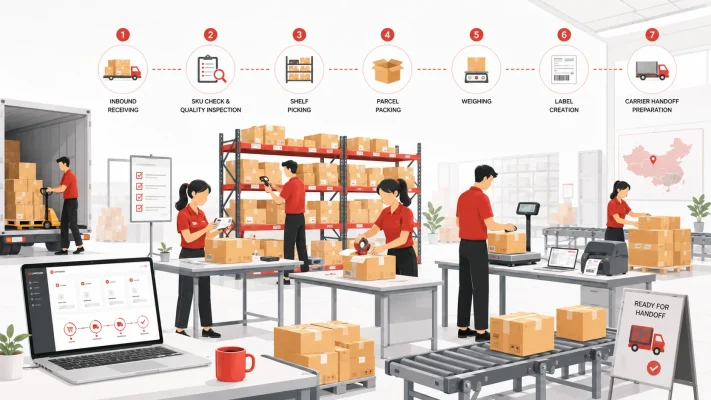
When the product reaches the warehouse, it is still not necessarily ready to leave China.
The warehouse may need to:
- Receive the item
- Match it to the correct SKU
- Inspect product condition
- Confirm the variant
- Add branded or neutral packaging
- Pick and pack the order
- Weigh the parcel
- Create the shipping label
- Wait for carrier collection
None of these tasks is unusual. The problem begins when nobody measures how long they take.
For example, a fast shipping route saves little if the order waits two days for inspection and another day for carrier pickup.
Good fulfillment services should make this part of the timeline visible rather than treating the entire warehouse stage as one generic status.
Three timestamps are especially useful:
- Product ready for fulfillment
- Parcel packed
- First carrier scan
If those timestamps are far apart, you know the delay is happening before international transportation.
4. The Shipping Route Still Matters—But It Is Only One Part
Once the carrier physically receives the parcel, the shipping method becomes much more important.
Dropshipping sellers generally balance three things:
Speed, cost, and reliability.
Express Shipping
Express courier services can be useful for high-value products, samples, urgent replacements, or orders where customers are willing to pay more.
The main advantage is speed and stronger tracking, but the higher cost makes express shipping unsuitable for many low-margin products.
Dedicated Ecommerce Shipping Lines
Dedicated ecommerce lines are often more suitable for ordinary dropshipping parcels because they aim to balance delivery speed and cost.
They can be a practical option for stores that need reasonable delivery times without paying express rates on every parcel.
Economy Shipping
Economy services can reduce shipping expense but may involve longer delivery windows or less predictable tracking.
They may work for lower-value products when customers have been given realistic expectations.
The right international shipping choice should therefore depend on the product, destination, weight, margin, and customer promise rather than simply choosing the cheapest quoted option.
Paying more for transportation also cannot recover time that was already lost upstream.
If a product takes four days to reach the warehouse, reducing carrier transit by one day does not solve the main problem.
5. Carrier Handoff Is a Common Blind Spot
There is an important moment between “label created” and “parcel moving.”
They are not the same event.
A warehouse can generate a tracking number before the carrier physically receives the parcel. The order may then remain at the warehouse or consolidation facility until collection.
This is why tracking can sometimes exist without meaningful movement.
For shipping time to US customers, monitor the first physical carrier scan rather than relying only on the moment tracking is uploaded.
Measure:
Label creation → first carrier scan
If this gap repeatedly becomes long, investigate:
- Warehouse cutoff times
- Carrier pickup schedules
- Weekend processing
- Consolidation schedules
- Incorrect shipping data
- Failed parcel handoff
This small metric can reveal delays that are easily mistaken for slow international transportation.
6. Customs and Product Information Can Affect Delivery
International parcels also need accurate shipment information.
Depending on the product and shipping method, important details can include:
- Product description
- Quantity
- Value
- Weight
- Country of origin
- HS code
- Required customs information
Not every customs delay can be prevented, but inaccurate or incomplete shipment information creates avoidable risk.
This is particularly important for products that have batteries, liquids, unusual materials, higher values, or other shipping restrictions.
Before scaling a product, confirm that the route actually accepts that product category rather than assuming every SKU can use the same line.
7. US Last-Mile Delivery Is Part of the Timeline Too
A parcel arriving in the United States does not mean it has reached the customer.
Many cross-border ecommerce routes eventually transfer packages to domestic last-mile networks.
Final delivery can vary according to:
- Destination region
- Remote versus urban address
- Incorrect address information
- Local carrier workload
- Weather
- Failed delivery attempts
This explains why two parcels shipped from China on the same day may not arrive on the same day.
For customer support, the key is knowing where responsibility currently sits.
If the parcel has not left the warehouse, contact fulfillment.
If it is moving internationally, investigate with the cross-border carrier.
If it has entered the final-mile network, check the domestic delivery status.
Do not restart the investigation from the beginning every time a customer asks, “Where is my order?”
How to Diagnose a Slow Dropshipping Order
Instead, locate the last confirmed physical event.
|
Current Order Status |
Likely Problem Area |
What to Check |
|
Supplier has not shipped |
Supplier or stock |
Availability and preparation |
|
Product moving inside China |
Domestic sourcing |
Supplier-to-warehouse progress |
|
Warehouse received product |
Inspection or fulfillment |
QC and packing status |
|
Label created, no movement |
Carrier handoff |
First carrier scan |
|
Moving internationally |
Cross-border logistics |
Latest tracking event |
|
Arrived in USA |
Customs or transfer |
Clearance and last-mile handoff |
|
Out for delivery / failed |
Last mile |
Address and delivery attempt |
This is a better way to diagnose shipping problems than simply saying, “The logistics company is slow.”
It also tells you which process actually needs improvement.
How to Reduce China to USA Dropshipping Shipping Time
Stock Proven Products
If an SKU sells consistently, keeping limited inventory at the fulfillment warehouse can remove supplier purchasing time from each order.
Do not stock every test product. Focus on products with stable demand.
Set Clear Supplier Lead Times
Track how long each supplier actually takes rather than relying on “ready soon.”
Supplier performance should be based on real order data.
Measure Warehouse Processing
Separate receiving, inspection, packing, and carrier handoff.
This makes it easier to identify where waiting time is being created.
Use Shipping Routes by Product and Destination
Do not force every product onto the same route.
Different products, weights, destinations, and restrictions may require different shipping options.
Monitor the First Carrier Scan
Tracking without physical movement needs attention.
Monitor the time between label creation and the carrier’s first scan.
Review Delayed Orders by Cause
After several weeks, you should be able to see whether most delays come from:
- Stock
- Suppliers
- Fulfillment
- International transit
- Customs
- Last-mile delivery
Once you know the answer, optimization becomes much easier.
Conclusion
Dropshipping shipping time from China to the USA is best understood as a chain, not a carrier estimate.
An order can lose time before it reaches the warehouse, while it waits for inspection, between label creation and carrier pickup, during international transportation, or after it reaches the United States.
The useful question is therefore not simply, “How fast is my shipping line?”
Ask where the order is waiting, how long that stage normally takes, and who is responsible for the next action.
Once those answers are visible, you can improve delivery speed without guessing—and give customers delivery expectations that your operation can actually support.
Frequently Asked Questions
It depends on product availability, supplier handling, warehouse processing, shipping method, customs, and final-mile delivery.
Faster orders may arrive in around a week under favorable conditions, while purchase-on-demand products or slower shipping routes may take several weeks.
The safest approach is to calculate delivery using recent orders for the same product, route, and destination.
Because the advertised shipping time may describe only the carrier transit stage.
The product may first need to be sourced, transferred to a warehouse, inspected, packed, and handed to the carrier.
Check the last confirmed physical event to identify where the order is actually waiting.
Measure every important stage separately:
- Supplier lead time
- Inventory availability
- Warehouse processing
- Carrier handoff
- International transit
- Customs
- Last-mile delivery
Improve whichever stage consistently creates the longest avoidable delay.
It can.
If stock is already available at the fulfillment warehouse, the order can skip supplier purchasing and domestic supplier-to-warehouse transportation.
This approach is most suitable for products with predictable sales.
No.
Express shipping mainly improves transportation time. It does not solve slow supplier processing, stock shortages, inspection delays, or warehouse waiting time.
If the main delay happens before dispatch, improving fulfillment may produce a larger result at a lower cost.
There is no single factor.
Product availability, supplier preparation, warehouse handling, carrier pickup, shipping route, customs, and US last-mile delivery all contribute to the final timeline.
The biggest delay can also vary by product and destination.
