










Finding a supplier is easy. Proving that the supplier can protect your customer experience is the difficult part. A polished profile, low quotation, or fast reply does not tell you whether orders will be packed correctly, dispatched on time, or handled properly when something goes wrong.
This guide explains how to find reliable dropshipping suppliers through a practical verification process rather than a supplier list. You will learn how to check business information, compare samples, test communication, confirm inventory and lead times, evaluate exception handling, and run a controlled trial order before committing.
The goal is not to find a “perfect” supplier. It is to identify a partner whose performance is predictable enough for your store to grow without constant operational surprises.
Start With Your Own Supplier Requirements
Before asking how to find reliable dropshipping suppliers, define what “reliable” means for your store. A supplier that works for a low-cost home accessory may be unsuitable for electronics, size-sensitive apparel, or branded beauty products.
Create a one-page requirement sheet covering:
- The exact SKU and product specification
- Materials, colors, sizes, and models
- Target countries
- Expected testing and scaling volume
- Maximum processing time
- Target delivery time
- Packaging requirements
- Tracking requirements
- Inspection standards
- Branding or labeling needs
This turns vague questions into testable ones.
Instead of asking, “Can you ship fast?” ask, “Can you dispatch this SKU within two business days when order volume reaches 30 orders per day?”
Instead of asking, “Is the quality good?” provide a list of the product details that must be checked, such as measurements, materials, stitching, surface finish, accessories, labels, packaging, or basic functions.
Send the same requirement sheet to every candidate. This allows you to compare operating capability rather than sales skill. Without a consistent brief, one supplier may quote basic packaging while another includes inspections, inserts, and faster shipping, making their prices impossible to compare fairly.
Build a Shortlist Before You Begin Supplier Verification
Begin with three to five realistic candidates. Remove suppliers that clearly fail your product, route, packaging, or volume requirements, but do not choose a winner from profile badges, reviews, or price alone.
Look for initial signs of operational fit:
- Experience with your product category
- Clear and consistent product specifications
- Understandable pricing
- Stated processing times
- Suitable shipping methods
- Willingness to provide business information
- Clear explanations of whether the company manufactures, trades, or sources the product
- Responses that address your actual questions
Pay attention to how the supplier responds to detailed requests. A generic message such as “best quality, fast shipping, good price” provides little useful information. A stronger response explains what is available, what needs confirmation, how long sourcing will take, and what limitations may apply.
When a product is difficult to source or offered by many similar factories, professional product sourcing can help compare candidates on product fit, sampling, communication, pricing stability, and supply capacity.
The aim is not to identify a winner immediately. It is to create a manageable group that can be tested under identical conditions.
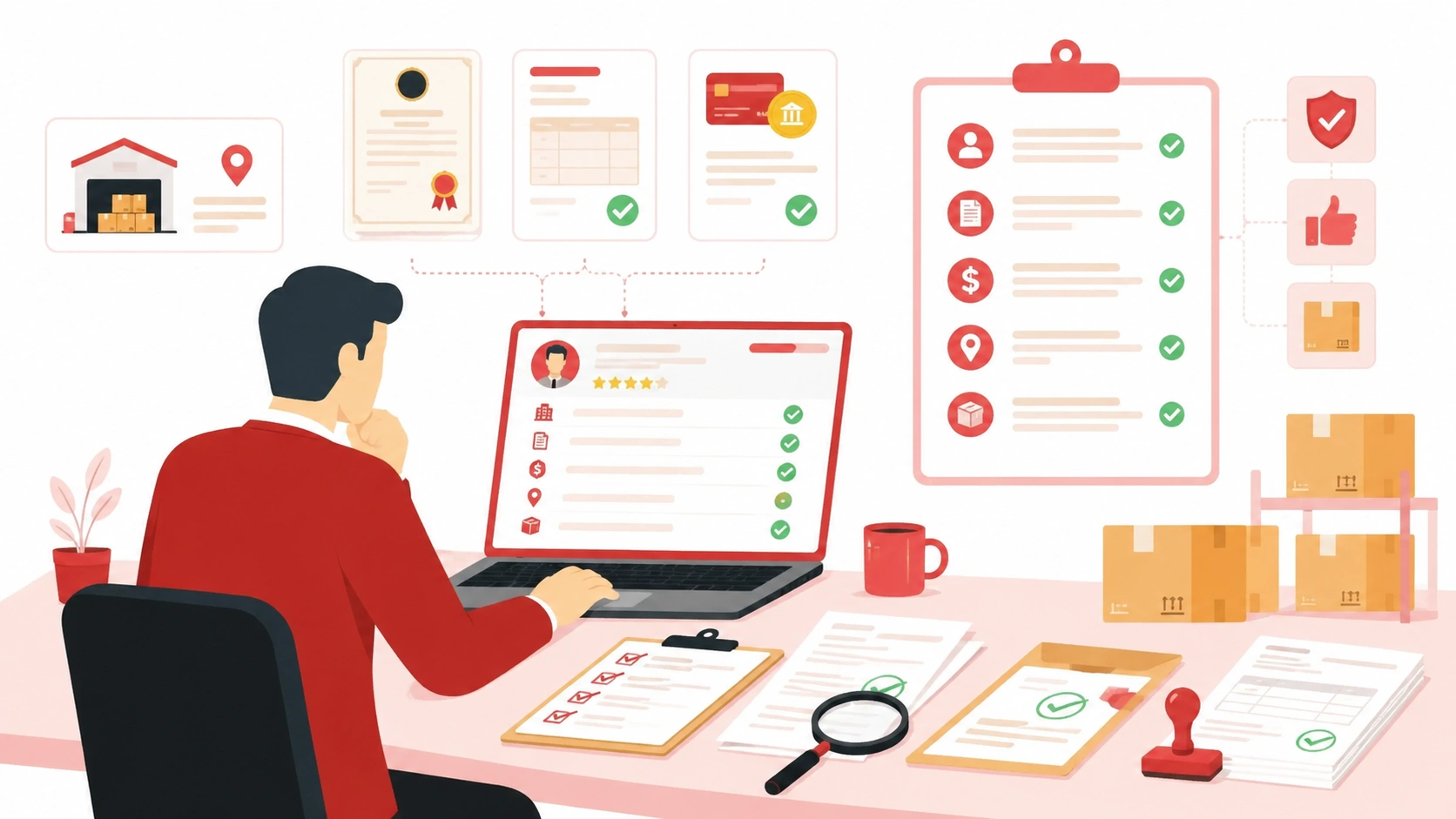
How to Vet a Supplier by Checking Its Business Identity
Business information does not prove that a supplier will perform well, but it helps confirm that you are dealing with a real operating entity. Supplier verification should begin with identity consistency.
Ask for the supplier’s:
- Registered company name
- Business license or registration document
- Operating address
- Contact person
- Business email address
- Invoice information
- Payment beneficiary details
Compare this information across business documents, quotations, invoices, payment requests, platform profiles, email signatures, and contracts.
Pay attention to mismatches. A small difference may have a reasonable explanation, such as a trading company working with a separate factory. However, the supplier should be able to explain the relationship clearly.
You should know:
- Who receives your payment?
- Who manufactures or purchases the product?
- Who owns or controls the inventory?
- Who performs the inspection?
- Who packs and dispatches the order?
- Who is responsible when something goes wrong?
Use the following questions during supplier verification:
- What is your full registered company name?
- Are you a manufacturer, trading company, sourcing provider, or fulfillment company?
- Where is the product manufactured?
- Where is the inventory stored?
- Who will issue the invoice and receive payment?
- Do you use subcontractors for production, packaging, or fulfillment?
- How long have you handled this product category?
- Can you provide recent product photos or a live video?
- Can you show the working, storage, or packing area?
- Who will be my main operational contact after payment?
A registration badge should be treated as a starting point rather than a performance guarantee. It may help confirm that a company is legally registered, but it does not automatically confirm product quality, stock accuracy, processing speed, production capability, or after-sales behavior. Those areas require separate testing.
Be cautious when a supplier avoids basic identity questions, pushes for immediate payment, changes payment accounts without explanation, or provides documents that do not match the company you have been speaking with.
Order Samples That Test the Entire Customer Experience
A sample is not only for checking whether the product looks good. It should test the supplier’s complete process from order confirmation to final delivery.
Order the same product from each shortlisted supplier using the same specification. When possible, ship the samples through the method you would actually use for customer orders.
A premium express sample may arrive quickly while hiding problems that appear during standard fulfillment. For example, the normal process may involve purchasing the item from another factory, waiting for it to reach a warehouse, repacking it, and then using a slower shipping route.
Record the following details:
- Time taken to confirm the order
- Time from payment to dispatch
- Accuracy of the SKU and variant
- Tracking activation time
- Total delivery time
- Packaging condition on arrival
- Product dimensions and weight
- Material and surface quality
- Color and size accuracy
- Product function
- Included accessories
- Labels and instructions
- Presence of supplier branding
- Presence of invoices or promotional cards
- Whether the delivered item matches the specification
- Communication during the shipment
Do not inspect only one perfect-looking unit. If the product has a higher quality risk, order several units or request a small sample batch. Consistency matters. One acceptable sample cannot prove that future orders will match.
Create a written inspection checklist for the specific product.
For apparel, check:
- Measurements
- Stitching
- Fabric
- Color consistency
- Labels
- Zippers or buttons
- Odor
- Packaging
For electronics, check:
- Basic function
- Charging
- Plugs
- Accessories
- Instructions
- Battery condition
- Surface damage
- Packaging protection
For beauty tools or accessories, check:
- Seals
- Leakage
- Labels
- Cleanliness
- Surface finish
- Color
- Included components
- Packaging condition
For products where defects could quickly create complaints or refunds, a defined product quality inspection process gives you better control than relying on a supplier’s general statement that every item is “checked.”
The important question is not whether an inspection exists. It is what is checked, how often it is checked, what evidence is provided, and what happens when a problem is found.
Take photos, measurements, and notes for every sample. This creates a reference standard that can later be used to compare production units, replacement items, or products from a backup supplier.

Test Communication Before You Depend on It
Fast replies during a sales conversation do not show how a supplier communicates under pressure. Reliable dropshipping suppliers should provide clear, specific, and consistent information, including when the answer is inconvenient.
Use realistic questions rather than asking only for a quotation:
- What happens if a variant sells out after a customer orders?
- How quickly will you notify me about a stock shortage?
- Who handles an address change before dispatch?
- What happens if tracking remains inactive?
- Can you support a temporary increase from 10 to 80 daily orders?
- Who pays when the warehouse sends the wrong SKU?
- What proof is required for a damaged parcel?
- How are cancelled orders handled?
- What is the escalation process for an urgent problem?
Evaluate the quality of the answer, not only the response speed.
A dependable contact should explain the process, identify limitations, and name the person responsible for the next action. A supplier that responds within five minutes but does not answer the question is not necessarily communicating well.
Watch for contradictions. If one salesperson promises two-day processing while another says five days, ask for a written standard. If the supplier provides different stock numbers within the same week, ask how inventory is updated and which number is reliable.
Communication should also remain stable after payment. Some suppliers are highly responsive during sales conversations but become difficult to reach when an order has already been placed.
Keep important terms in email, quotations, order agreements, or another reviewable record. Verbal promises and scattered chat messages are difficult to use when a dispute occurs.
Verify Inventory Instead of Accepting “In Stock”
Inventory is one of the most common sources of dropshipping disruption. A product page can remain active even when the actual SKU is unavailable, low in stock, being replaced, or waiting for a new production run.
Ask what “in stock” means in the supplier’s system.
Does it refer to:
- Inventory physically available in the warehouse?
- Inventory located at a separate factory?
- Inventory shared among several sales channels?
- Raw materials available for production?
- A product that can be purchased after the order is placed?
Request SKU-level information rather than a general product count. A supplier may have 2,000 units of a product family but only 20 units of the color and size that your customers are most likely to buy.
Useful inventory questions include:
- How often is stock updated?
- Can stock be reserved for active campaigns?
- What is the current quantity for each important variant?
- What is the replenishment lead time?
- Is there a minimum quantity for reserved stock?
- Will you notify me before a SKU becomes unavailable?
- Do you have an alternative product or backup factory?
- How are discontinued variants communicated?
- Is the product physically available or purchased after receiving an order?
- How much volume can be processed without additional preparation?
Test stock accuracy during the trial period. Ask for inventory confirmation on different days and compare the answers with actual processing.
A supplier that repeatedly confirms stock and then delays dispatch has an inventory visibility problem, even if the product eventually ships.
For a product you expect to scale, discuss a basic stock plan before launching a large campaign. This may include:
- Sharing a sales forecast
- Setting a replenishment trigger
- Reserving stock
- Holding safety stock
- Preparing packaging materials
- Confirming backup production capacity
The correct arrangement depends on your volume, cash flow, and product risk. However, the conversation should happen before a successful campaign creates more orders than the supplier can process.

Separate Processing Time From Shipping Time
A supplier may advertise fast shipping while still taking several days to source, receive, inspect, and pack the product. Customers experience the total time from placing an order to receiving it, not only the carrier’s transportation time.
Break the timeline into separate stages:
- Order received
- Product allocated or purchased
- Product delivered to the fulfillment location
- Inspection completed
- Packing completed
- Parcel handed to the carrier
- Tracking activated
- International transportation
- Final delivery
Ask for both the normal and delayed time range for each stage. During sample and trial orders, record actual processing, tracking activation, and delivery performance by product, carrier, and destination country.
A supplier does not need to promise that delays will never happen. It needs a process for detecting delays early, reporting them clearly, and offering practical alternatives.
Review the Fulfillment Workflow Step by Step
Reliable dropshipping suppliers should be able to explain how an order moves from your store to the carrier.
Ask how:
- Orders are received
- SKUs and variants are matched
- Customer addresses are checked
- Out-of-stock orders are identified
- Products are inspected
- Packaging requirements are stored
- Tracking numbers are generated
- Tracking information is returned
- Changed orders are handled
- Cancelled orders are stopped
- Failed deliveries are recorded
- Returned parcels are processed
Check customer-facing details during the sample and trial stages. Look for:
- Weak packaging
- Incorrect labels
- Supplier logos
- Price information
- Unexpected invoices
- Promotional cards
- Missing accessories
- Incorrect instructions
- Poor protection for fragile items
For branded orders, confirm what happens when custom packaging or inserts run out. Ask how the correct packaging materials are linked to each product and how staff know which orders require branding.
Do not assume that one successful customized sample proves the process can be repeated. The supplier should have a clear method for storing packaging instructions and checking them before dispatch.
Also confirm the daily order cutoff and the supplier’s time zone. An order submitted in the afternoon in your country may arrive after the supplier’s cutoff and lose an additional processing day.
If you use Shopify, ask whether the supplier supports an app, API, ERP connection, CSV process, or another workflow that reduces manual copying. A spreadsheet may work during testing, but it becomes riskier as volume grows.
Stress-Test Exception Handling Before a Real Crisis
Normal orders show whether a supplier can follow the happy path. Problem scenarios show whether it can protect your business.
Before approval, ask the supplier to walk through several exceptions:
- The customer ordered the wrong size and requests a change before dispatch
- The product becomes unavailable after payment
- The wrong item is packed
- The tracking number does not update
- The parcel is damaged in transit
- The carrier marks the parcel delivered, but the customer cannot find it
- A product defect appears after delivery
- A customer returns the parcel
- A sudden order spike exceeds available stock
For each scenario, clarify:
- Notification time
- Evidence required
- Decision maker
- Replacement process
- Refund responsibility
- Reshipping cost
- Resolution time
- Customer communication
- Escalation contact
A trusted supplier checklist should include the difficult questions that sales pages rarely answer.
Who pays for reshipping when the warehouse sends the wrong SKU? What evidence is required for a defect claim? Is a replacement sent immediately, or only after the carrier completes an investigation? How long will the supplier wait before declaring a parcel lost?
You do not need every outcome to favor the seller. You need the policy to be clear, reasonable, and usable. Ambiguous responsibility creates long disputes and slow customer support.
Consider sending a controlled problem during testing. For example, request an address correction before dispatch, ask to change a variant, or report a minor sample issue.
The goal is not to trick the supplier. It is to see whether the stated process works when an order requires manual attention.

Run a Small-Batch Trial Order
A sample proves that a supplier can complete one order. A small-batch trial shows whether it can repeat the process.
Start with a limited number of real or controlled orders. Choose different variants, shipping destinations, and order times when possible. Avoid sending your full sales volume to a supplier that has completed only one successful sample.
Track every trial order in a spreadsheet. Include:
- Order date and time
- SKU and variant
- Stock confirmation time
- Processing time
- Dispatch date
- Tracking activation date
- Delivery date
- Product accuracy
- Packaging result
- Customer or tester feedback
- Communication issues
- Exception details
- Resolution time
- Additional costs
The trial should be large enough to reveal patterns but small enough to limit damage. There is no universal number of trial orders because product risk and store size vary.
A simple, low-cost item may require fewer checks than a fragile, regulated, customized, electronic, or size-sensitive product.
Do not change several variables at once. If you switch the product, carrier, packaging, and supplier simultaneously, you will not know what caused a problem.
Keep the test controlled and compare every candidate against the same expectations.
Score Suppliers With Evidence, Not Impressions
After the trial, use a weighted scorecard. This prevents one attractive feature, such as a low price or friendly salesperson, from dominating the decision.
A practical scorecard could include:
|
Evaluation Area |
Suggested Weight |
What to Measure |
|
Business identity and transparency |
10% |
Information consistency, company role, payment identity |
|
Product quality and consistency |
20% |
Sample accuracy, defects, variation between units |
|
Communication |
15% |
Response clarity, ownership, updates, written confirmation |
|
Inventory accuracy |
10% |
SKU visibility, stock alerts, replenishment information |
|
Processing and delivery |
20% |
Dispatch time, tracking activation, route performance |
|
Fulfillment accuracy |
10% |
Correct SKU, address, packaging, labels, accessories |
|
Exception handling |
10% |
Speed, evidence, responsibility, replacement or refund process |
|
Commercial fit |
5% |
Total cost, payment terms, scalability, packaging options |
Adjust the weights for your business.
Product quality may deserve more weight for beauty, electronics, pet, fashion, or branded products. Processing and delivery may deserve more weight when your store competes on fast shipping.
Set minimum pass conditions as well as a total score. A supplier should not pass if it refuses to verify its business identity, repeatedly sends the wrong product, cannot meet a critical quality requirement, or consistently provides inaccurate stock information.
The final decision should answer three questions:
- Can this supplier meet the current requirement?
- Can its process remain stable when order volume increases?
- Can your team detect and resolve failures before they become customer complaints?
Continue tracking these areas after approval. Supplier performance can change when order volume, production schedules, employees, factories, or shipping routes change. Review recent order data regularly and prepare a partially tested backup supplier for important products.

Red Flags That Should Slow Down Your Decision
Pause and investigate further when a supplier:
- Offers a price far below comparable quotations without a clear reason
- Refuses to provide basic company information
- Pushes for payment before specifications are confirmed
- Changes the payment account unexpectedly
- Cannot provide current product photos or video
- Gives inconsistent stock figures
- Provides vague or changing lead times
- Refuses a sample order
- Sends a different product from the quotation
- Cannot explain its inspection process
- Has no defined replacement rules
- Provides tracking that remains inactive
- Becomes difficult to reach after payment
A supplier that clearly says, “We cannot support that packaging yet,” may be safer than one that agrees to everything. Reliable operations usually have boundaries and can explain them.
When a Dropshipping Agent Makes More Sense
Direct supplier management can work when you sell a small number of products and can coordinate sourcing, inspection, fulfillment, shipping, and after-sales issues yourself.
It becomes more difficult when several factories are involved, products require different inspections, custom packaging must be managed, or daily order volume increases.
A dropshipping agent service can coordinate upstream suppliers, inspections, packaging, shipping routes, tracking, and exceptions in one workflow.
An agent should still be vetted. Ask:
- How are suppliers selected?
- What inspection is included?
- Where are products stored?
- How are orders transferred?
- Which shipping routes are available?
- How are stock shortages reported?
- How are problems documented?
- Who handles urgent exceptions?
The same principle applies whether you work with a factory, trading company, sourcing company, or agent: verify the operating process rather than relying only on the promise.
Conclusion
Learning how to find reliable dropshipping suppliers is not about discovering a secret directory or choosing the company with the highest rating. It is about building a verification process that exposes risk before your customers do.
Start with clear requirements. Confirm the supplier’s identity. Order samples that test the complete customer experience. Measure communication, stock accuracy, processing time, packaging, tracking, and exception handling.
Then run a controlled small-batch trial and score the results against standards that matter to your store.
The strongest supplier is not necessarily the cheapest, largest, or fastest during the sales conversation. It is the one that gives you the most predictable combination of product quality, fulfillment accuracy, honest communication, and practical problem resolution.
That predictability is what allows a dropshipping store to scale without turning every new order into a new risk.
FAQs
Start by defining the product specification, target countries, acceptable processing time, quality requirements, and return expectations. Shortlist several candidates, verify their business information, order comparable samples, test communication, and run a small trial before moving real order volume.
New sellers should avoid selecting a supplier only because it has the lowest price or a polished platform profile.
Use several types of evidence. Check the registered company information, compare it with invoices and payment details, confirm the supplier’s role, inspect samples, verify stock by SKU, and measure actual fulfillment performance.
Supplier verification is strongest when documents, communication, and real order results all support the same conclusion.
The number depends on product risk. One sample may be enough for an early comparison of a simple item, but it cannot prove consistency.
For products with sizing, color, material, function, packaging, or safety concerns, test several units or a small sample batch. The goal is to understand both average quality and variation between units.
Ask for stock by SKU and variant, the date of the latest stock update, replenishment lead time, and whether the inventory is physically available or still needs to be purchased or produced.
Compare those answers with actual processing during trial orders. Repeated delays after an “in stock” confirmation indicate weak inventory visibility.
A trusted supplier checklist should cover business identity, product specifications, sample quality, communication, SKU-level inventory, processing time, shipping performance, packaging, tracking, exception handling, payment details, and trial-order results.
It should also include minimum pass conditions so that a serious failure cannot be hidden by a good total score.
Ask questions that reveal the operating process:
- Who owns the inventory?
- How often is stock updated?
- What is the order cutoff time?
- What inspection is performed?
- How are wrong items, lost parcels, and defects handled?
- Who pays for replacements?
- What happens during an order spike?
Clear process questions are more useful than simply asking whether the supplier is “reliable.”
A primary supplier can simplify communication and order management, but important products should have a backup option. The backup should be sampled and partially tested before it is needed.
Using multiple uncoordinated suppliers can create additional complexity. The goal is not to add suppliers unnecessarily. It is to reduce dependence on a single point of failure.
Consider pausing or replacing a supplier when it repeatedly provides inaccurate stock information, misses agreed processing times, sends inconsistent products, avoids responsibility for errors, or fails to communicate serious delays.
One isolated issue can often be corrected. A repeated pattern without measurable improvement means the risk is becoming part of the supplier’s normal operation.
